What to Expect in the First 30 Days With an Outsourced Team


About us
MoldoWEB is a software development company, located in Romania, specialized in providing outsourcing and team augmentation services for clients around the world.
Table of contents
- Week 1: Getting Everyone on the Same Page
- Week 2: Aligning Processes and Workflows
- Week 3: First Deliverables and Feedback
- Week 4: Evaluation and Next Steps
- Tips for a Smooth First 30 Days
- Conclusion
Outsourcing IT development gives you an opportunity to work with skilled professionals from all over the world to handle different parts of your projects.
For businesses new to outsourcing a project to a remote development team, it’s normal to wonder how the collaboration will actually work, especially in the first few weeks. The good news is that a little structure early makes the entire process smoother.
Let’s walk through what actually happens in the first month when you outsource your project, week by week. We’ll break down the process, from onboarding and initial tasks to feedback and evaluation, and share tips on how to start the collaboration off right.
Week 1: Getting Everyone on the Same Page
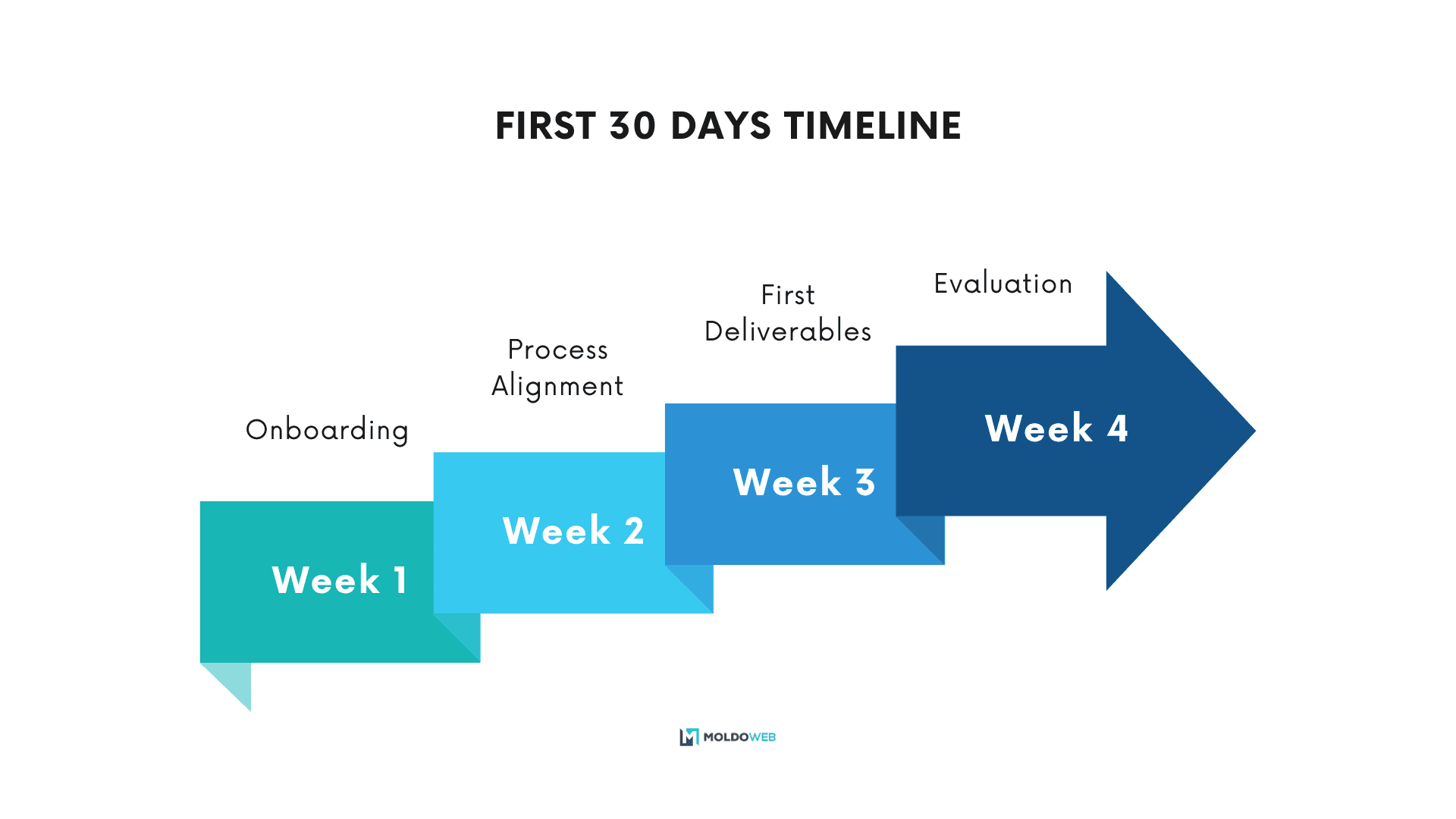
The first week with an outsourcing development team is the most important when it comes to defining how you’re going to work together. It sets the tone for the entire collaboration, whether that’s long - or short-term.
So, how should the first week look with your outsourcing team? Spoiler: it’s not about jumping in and writing code straight away. The first week is for laying the groundwork: this is the time to introduce the team to your project, sharing access to repositories, setting up accounts, and of course, clarifying who’s responsible for what. A good onboarding strategy from the start makes the entire collaboration more efficient.
Instead of assigning tasks in the first week, focus more on sharing the context around your project and explaining what success looks like. When developers know the exact goals, they work better.
The first week’s important tasks also include setting up your communication channels. Slack, email accounts, Jira, GitHub comments: decide where questions go, where updates happen, and how often check-ins should be. A little clarity here saves a lot of back-and-forth later.
By the end of the first week, your team should have access to your tools, communication channels, and the context they need to start delivering.
Week 2: Aligning Processes and Workflows
By week two, the “hello world” phase is over. The outsourcing team is introduced to your tools, and everyone knows each other’s names. Now you start seeing how things actually function, not just how they looked in the kickoff call.
This is the week when small friction points can show up. Maybe tickets aren’t detailed enough, code reviews might take longer than expected, or standups feel too long…or too short. That’s normal. It’s better to catch these things now than three months in.
From a developer’s perspective, this is where you define how tasks move from backlog to done. You don’t need a perfect process. Just keep it simple, clear, and predictable. Developers care less about whether you use Scrum, Kanban, or a hybrid setup, and more about what happens after they push code.
Week two is also a good time to offer early feedback. If something feels off, say it early. Keep communication open. Good software development companies want a smooth collaboration just as much as you do.
Week two will give you an insight into how you’re going to work together and adjust where it’s necessary. Don’t expect everything to click immediately. Look at whether things are moving in the right direction, and make small adjustments as you go.
| Challenge | Why it happens | Simple fix |
|---|---|---|
| Vague tickets | Assumed shared context | Add clear acceptance criteria |
| Slow code reviews | Undefined expectations | Set review timelines |
| Overlong meetings | No clear agenda | Time-box standups |
| Rework on tasks | Misunderstood requirements | Clarify before development starts |
Week 3: First Deliverables and Feedback
In week three, the actual work starts, and you receive the first deliverables from your remote development team. In this phase, the code starts speaking for itself, and it’s time for feedback and review.
Think of week three as the first real test of alignment, to see how everything you’ve discussed translates into practice. Did your team understand the requirements correctly? Are they prioritizing the right things? This is the time to answer questions like these. Small mismatches can show up here, but that is normal.
This week is less about judging performance and more about fine-tuning collaboration to avoid bigger misunderstandings later. Clear and practical feedback helps a lot.
In week three, the focus should be on testing how you work together, and adjusting / improving where needed.
Week 4: Evaluation and Next Steps
The first month is wrapping up with week four, and now's the time to evaluate and plan for the next steps. After setting up processes, and receiving the first deliverables, you have a pretty good idea about how the team operates under real conditions.
But this week is still about learning and adjusting. Think about what processes worked well, if there were any blockers slowing the team down, and implement ways to improve for the future.
This is also a time to plan for next steps. This can include things like refining the workflow, adding more frequent check-ins, or even adjusting priorities. You’re still in the initial phase of collaboration, so making minor changes can be easily done. Just make sure both your in-house team and the outsourced developers are on the same page and fully synced.
This will make the outsourcing development team feel like a true extension of your organization instead of just an external provider handling tasks.
Tips for a Smooth First 30 Days
The first month with your outsourcing team is important, because it sets the tone for the entire duration of the project. The focus should be on getting on the same page, addressing any uncertainties, and clarifying how the collaboration will actually work.
Be more precise with tickets. Write clear and detailed tasks and include links to relevant docs. “Implement login” and “Implement login with Google OAuth, store tokens securely, handle expired sessions” are two very different things. The more specific you are, the better the development goes.
Treat code reviews more like a conversation, not an inspection. If something doesn’t match your expectations, always explain the reasoning behind your standards.
And finally, we cannot stress this enough: don’t wait until the month is up to speak up. If a workflow feels off, updates aren’t detailed enough, or if there’s anything that you’d change, address it early. Small corrections in week two are much easier than big resets in month three.
The goal in the first 30 days is to build a rhythm that’s clear and predictable for the whole team.
Conclusion
Here’s the truth: after 30 days with an outsourcing team, you won’t know everything, but you’ll know enough.
You’ll know if communication feels natural or forced.
You’ll know if feedback turns into improvements or into friction.
You’ll know if the team is just completing tasks… or actually thinking with you.
And if something feels off? That’s useful too. The first 30 days are the cheapest time to adjust expectations, refine workflows, and reset priorities.