How Much Does It Cost to Maintain Custom Software After Launch?

About us
MoldoWEB is a software development company, located in Romania, specialized in providing outsourcing and team augmentation services for clients around the world.
Table of contents
- What software maintenance actually means
- The Different Types of Software Maintenance
- How Much Do Companies Usually Spend on Maintenance?
- Software Maintenance Cost Factors
- How to Keep Maintenance Costs Under Control
- Conclusion
Launching a custom web application is a huge business milestone. It marks the culmination of months of effort, and it’s definitely a good time to celebrate. But a week later, as the first support tickets start rolling in, the database slows down, and suddenly, the excitement meets reality.
Software maintenance plays a not-so-exciting, but just as important role in software development, as launching. It includes tasks like bug-fixing, performance improvements, updates, security patches, and adapting to changing business needs.
Businesses often underestimate the maintenance part of their projects, especially when it comes to the ongoing costs. So, we wanted to clear the air around post-launch software maintenance expenses, common pitfalls that inflate budgets, and how to plan for long-term software sustainability. Let’s get started.
What software maintenance actually means
When people hear “software maintenance”, they often imagine occasional bug fixes. But in reality, it’s a much broader part of running software in production.
Bug fixing is indeed an important part of application maintenance and support. No matter how carefully something is tested before launch, real users will always find edge cases / new issues. This can happen for many different reasons: someone logs in with a browser you didn’t test, or a file upload behaves differently with larger files. Fixing these issues as soon as possible keeps the product reliable, and your users won’t lose trust.
Then there are security issues. Dependencies, frameworks, and libraries evolve constantly. When a security threat appears in something your app relies on, it needs to be patched. Ignoring these can lead to real risks.
Another part of maintenance is performance and infrastructure adjustments. As your user base grows, systems that worked fine during launch can start slowing down. Databases need indexing, APIs might need optimization, and teams often have to scale to handle more traffic.
Then, there’s compatibility work. Browsers update, mobile operating systems change. Even if you’re not adding new features to your product, some adjustments are still necessary from time to time to keep your app running.
And let’s not forget technical debt cleanup. Most software launches with a few shortcuts along the way, and that is normal. Maintenance time is often when teams refactor pieces of code and make the system easier to extend later.
The Different Types of Software Maintenance
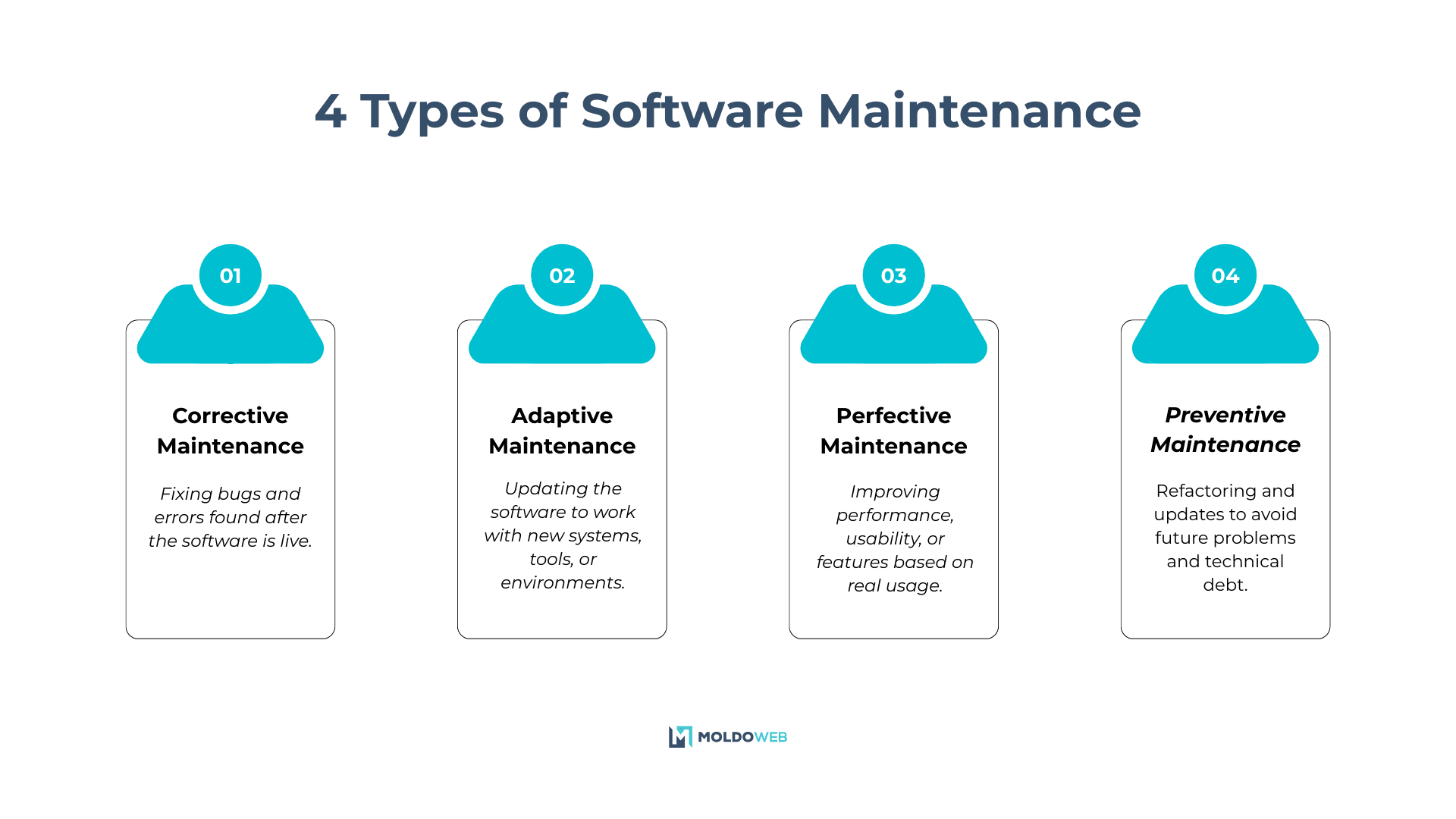
Not all maintenance work looks the same. In software engineering, maintenance usually belongs in four categories. In practice, most development teams end up doing a mix of all four after launching the product.
Corrective Maintenance
This is the most obvious one: fixing things that break.
Even if there’s plenty of testing before launch, real users will always find scenarios the team wasn’t expecting. So, corrective maintenance is simply the process of finding those issues and fixing them, so that the system stays reliable.
In most cases, this type of work appears regularly, but usually in small bursts.
Adaptive Maintenance
Software rarely runs in a static environment.
Operating systems update, browsers behave differently. Cloud infrastructure evolves. Adaptive maintenance is the work that helps keep the software compatible with these external changes.
Perfective maintenance
Once the product goes live, and users start interacting with it, the team gets a better idea of what needs to be improved.
Maybe a page loads slower, or a workflow could be simplified. Perfective maintenance is all about improving performance, usability, and efficiency, even if the system already works.
In most successful products, this type of maintenance becomes the largest part of post-launch work.
Preventive Maintenance
Preventive maintenance is the work that helps avoid bigger problems later.
It can include things like refactoring messy code, updating outdated dependencies, or restructuring parts of the system that could become fragile over time.
Preventive maintenance might not look like urgent work, but teams that keep investing in it regularly tend to avoid large tech debt later.
How Much Do Companies Usually Spend on Maintenance?
When it comes to software maintenance costs, multiple factors influence them. So, there isn’t a single universal figure. The maintenance cost, just as custom software development cost depend heavily on the size of the product, the tech stack involved, or how quickly the systems grow after launch. But across many real projects, a pattern does show up: most companies end up spending somewhere between 15% and 25% of the original development cost per year on maintenance.
So, let’s say if a product costs $100,000 to build, the yearly software maintenance cost might require $15,000 - $25,000 to keep everything running smoothly and secure.
This number can be lower for smaller applications with predictable usage. In such cases, maintenance is often handled by a single developer for a few hours per week.
But for larger systems with higher traffic and more complex integrations, maintenance costs may be higher. A small dedicated team might also be necessary to handle this part of development.
An important factor that affects costs is how clean the codebase is after launch. Products built quickly without much time for refactoring might need more effort later. And systems with solid architecture and regular updates are usually cheaper to maintain.
One thing experienced teams learn over time is that maintenance spending rarely stays perfectly flat. This means that some months can be quiet, while others involve infrastructure changes or performance improvements that require more effort and attention.
Software Maintenance Cost Factors
When your product goes live, maintenance doesn’t come from a single place. They are influenced by multiple factors.
App complexity
The more complex your system is, the more effort it takes to maintain. A simple internal tool with minimal workflows is very different from a platform with multiple user roles, integrations, and features.
Complex systems have more dependencies, more edge cases, and more infrastructure involved. All these factors naturally increase the time needed for maintenance activities like testing, troubleshooting, updates, etc.
Frequency of updates
Some products evolve constantly, while others remain stable for longer.
If your business regularly launches new features or adapts to changing market needs, application maintenance and support become a more active process. Every update needs testing, deployment, and constant improvements.
Stable products with fewer changes typically require less ongoing maintenance work.
Security requirements
Security expectations also play a role in maintenance costs.
For applications working with sensitive data, transactions, or personal information, regular security updates and monitoring are absolutely necessary. This can include dependency reviews, vulnerability scans, regular improvements, and implementing security best practices.
User growth and system load
As usage increases, most systems need adjustments to maintain performance.
More users mean more database activity, more server load, and more traffic moving through the app. At a certain point, developers may need to optimize queries, introduce caching, and scale infrastructure to handle the demand.
Documentation and knowledge transfer
This factor is often overlooked.
When documentation is clear and the architecture is well understood, developers can investigate issues and implement changes much faster. Without it, even small fixes will need extra time just to understand how parts of the system interact.
But over time, good documentation can significantly reduce maintenance efforts.
| Factor | Lower Maintenance Cost | Higher Maintenance Cost |
|---|---|---|
| Application complexity | Simple workflows, few dependencies | Clear documentation, clean architecture |
| Frequency of updates | Rare changes, stable features | Frequent releases, constant improvements |
| Security requirements | Rare changes, stable features | Sensitive data, strict compliance, regular audits |
| Security requirements | Small number of users | High traffic, scaling infrastructure |
| Documentation & knowledge | Clear documentation, clean architecture | Poor docs, hard-to-understand code |
How to Keep Maintenance Costs Under Control
Maintenance doesn’t have to break the bank. You can keep maintenance costs under control and predictable with a bit of planning.
First thing you can do is invest in clean, maintainable code from the start. This way, you’re setting yourself up for success and spending less time and money on maintenance. Messy code is like leaving a ticking bomb for future developers. Make sure your code is well-documented, modular, and easy to read.
Also, plan for regular updates. Don’t wait until issues pile up, because that will just make maintenance expensive and stressful. Small, frequent updates, like patching bugs or improving security, are easier to manage than massive overhauls.
Prioritize based on impact: focus on what affects users or system stability the most. Minor aesthetic improvements or low-priority features can wait. Make sure your team spends time where it matters.
Automate processes where possible. Automated tests, monitoring, and CI/CD pipelines catch problems early, and they save hours of manual work. And reduce the risk of downtime.
Communicating regularly within your team is also a good way to keep everything in check. If everyone on the team, including product managers, developers, and stakeholders, is all on the same page at all times, you avoid costly issues. Clear tickets and regular check-ins make a huge difference.
Conclusion
Maintenance is ongoing work, but it doesn’t need to be completely unpredictable. With a proactive approach, you can keep costs manageable and your app running smoothly.
Think of it this way: MVP proves your idea, but ongoing maintenance makes sure that it actually works for real users, and keeps growing without surprises.
The teams that approach maintenance strategically spend less time fixing and more time building value.